
5th Period of Biblical History
Medieval Period
638 CE – 1918 CE
Sponsored By: Available
Rome’s control of Syria Palaestina was interrupted in 221 CE during what has been called “The Imperial Crisis,” a fifty-year period when everyone suffered from the impact of foreign invasions, civil strife, plagues and economic depression. Not only did the empire survive, but so did Tamar. The site was chosen as one of the main military establishments to be rebuilt by the Romans, bigger and better than ever, alongside the much traveled highway leading into and out of “occupied territory.”
But in 363 CE the Roman presence ended abruptly as the town and its impressive structures were destroyed in a massive earthquake. Tamar, or En Hatzeva, however, was still an oasis where people could refresh themselves beside the cool waters, and sometimes discuss or even convert to new religions. After primeval polytheism, came monotheism, then Judaism and Christianity, followed by Islam.
Muhammad arrived on the scene in the sixth century and seems to have considered himself a “restorer” of the monotheistic faith started by Adam, handed down to Noah, through Abraham, to Moses, and the other prophets. He embraced Jesus as one of the earlier prophets, but Muhammad’s Muslim recruits believed him to be “the Last Prophet of God,” much like Christians thought of Jesus as “the only Son of God.” He got his inspiration from the angel Gabriel and taught that “the people of the Book” (Christians and Jews) were to be respected, but not necessarily treated as equals. Pagans, on the other hand, would be forced to convert or die.
Subsequent years of Islamic control did not prove to be good ones for most Jews, Christians, pagans, or the newly conquered territories. There was little interest on the part of Jihadist invaders to protect the land or the historic places, except for the Temple Mount and the burial place of the Patriarchs in Hebron. Tamar thus became a lonely outpost serving Arab soldiers, Ottoman Turks, and Bedouin tribesmen as they traversed ancient pathways between Mecca and Jerusalem.
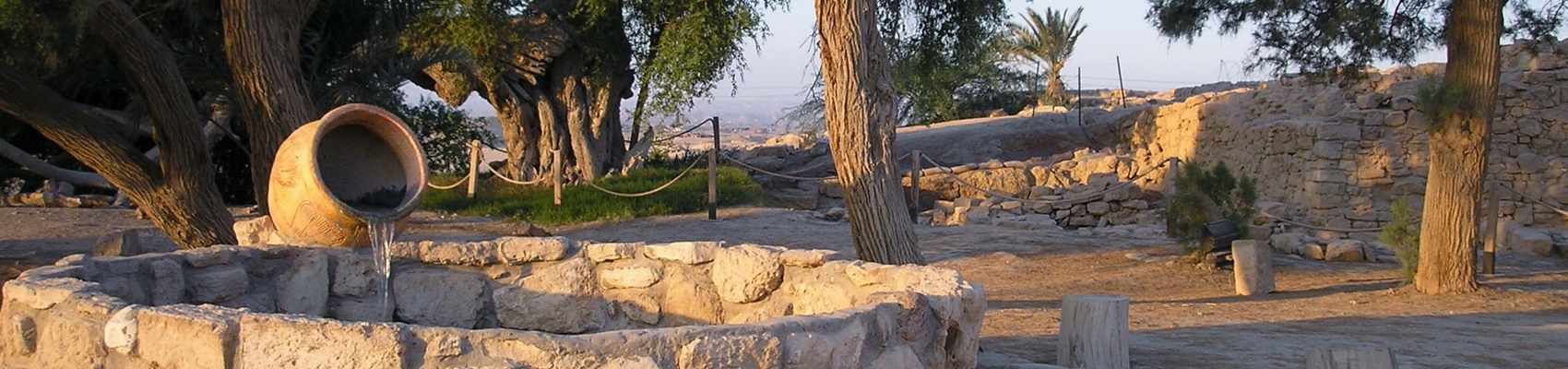
 Ruins at Biblical Tamar Park leftover from the Islamic Period.
Seven Historical Periods of Israel

Abrahamic Period
learn more

Moses Period
learn more

Israelite Period
learn more

Greco-Roman Period
learn more

Medieval Period
learn more

British Period
learn more

Israeli Period
learn more